InsightsDesign Thinking
10 Jun 20269 min read
Design Thinking Is Not a Process
Design thinking has been misunderstood as a five-step innovation process. It is something more fundamental: a way of reasoning about uncertainty.
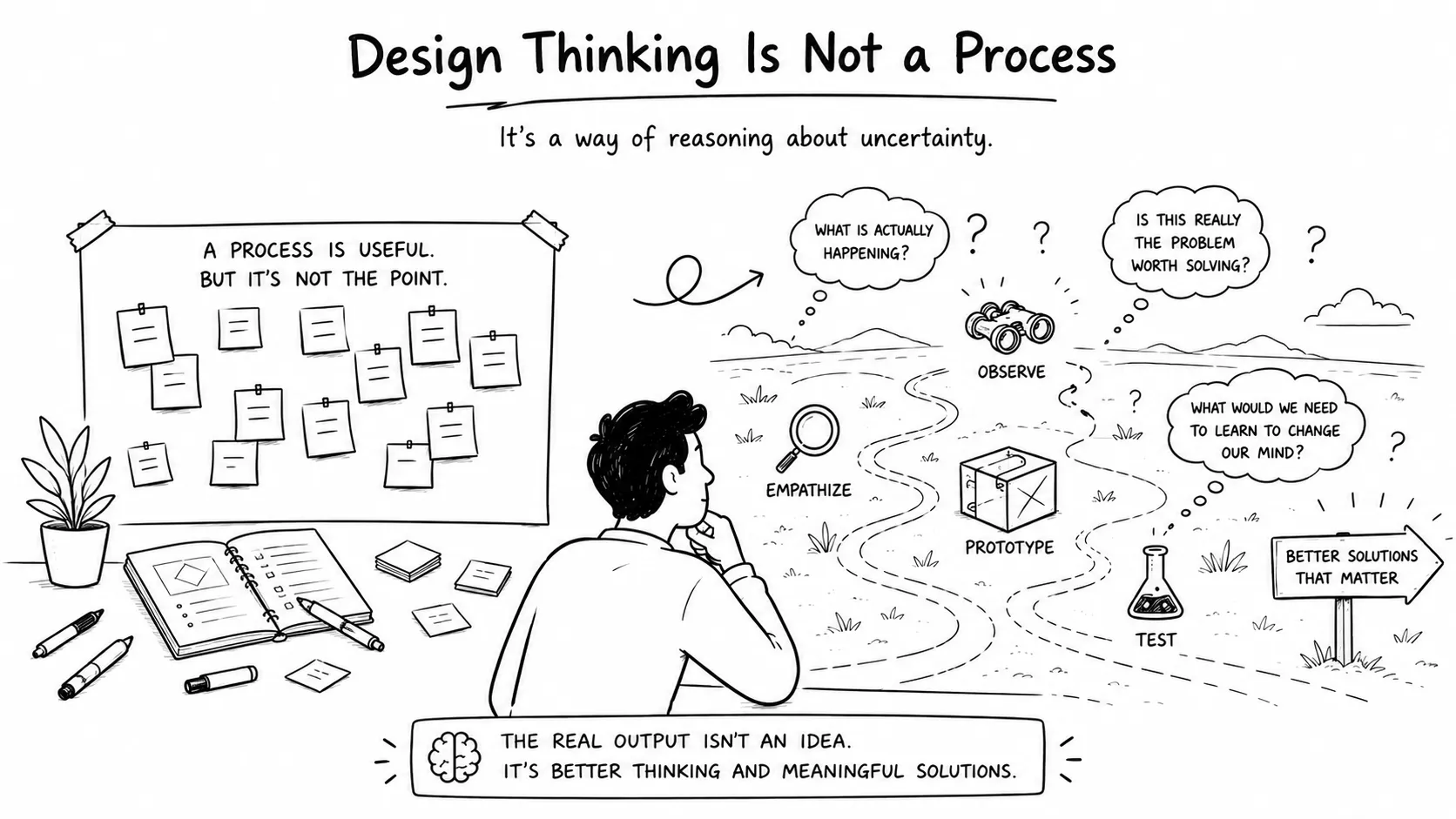
Design thinking was meant to help us deal with uncertainty, ambiguity and problems worth exploring. Somewhere along the way, it became a five-step recipe, a workshop format and a collection of sticky notes. The tools survived. The thinking often got lost. AI now makes that distinction harder to ignore.
The misunderstanding
For years, design thinking has been packaged as a process.
- Empathize.
- Define.
- Ideate.
- Prototype.
- Test.
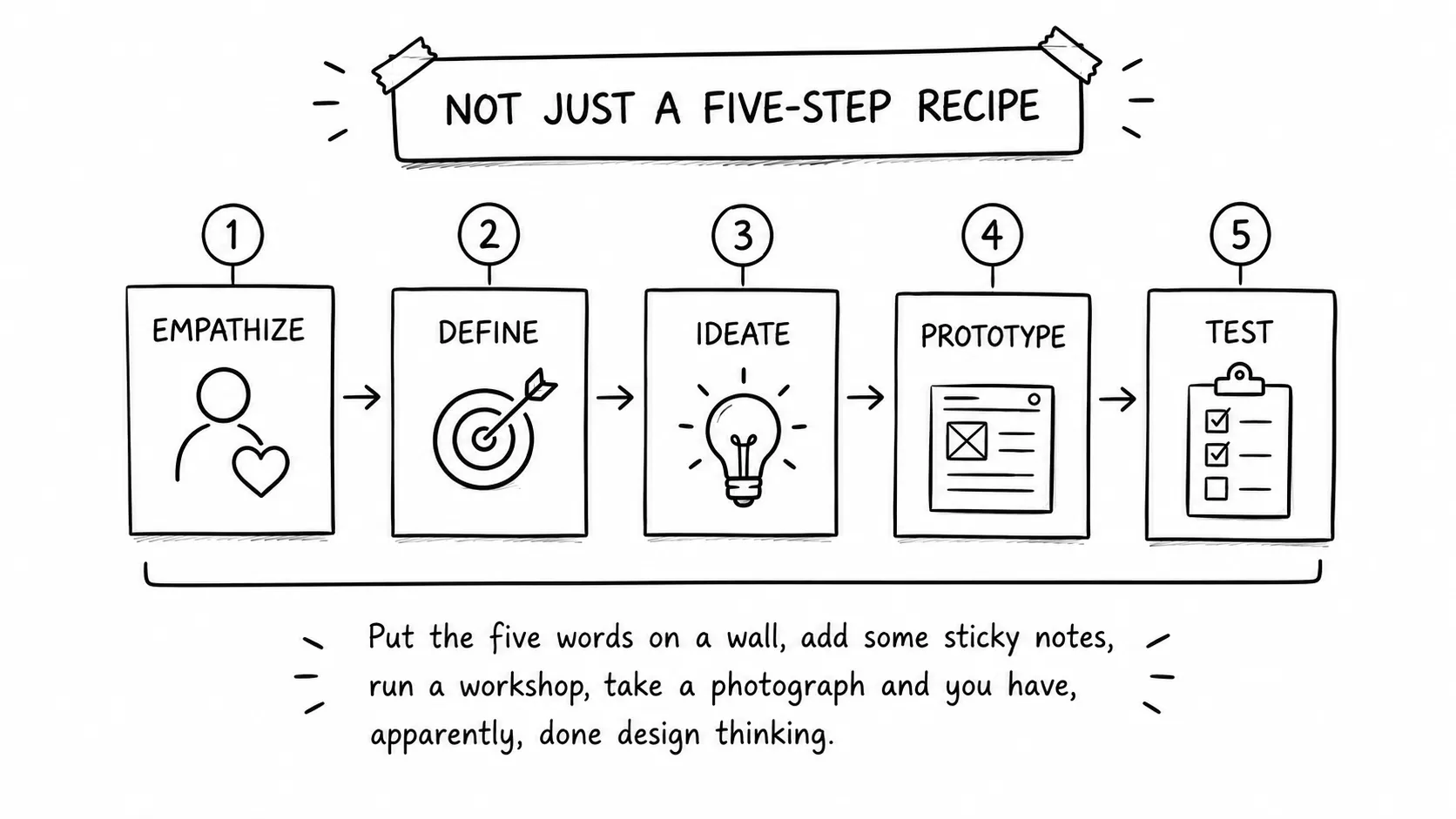
Put the five words on a wall, add some sticky notes, run a workshop, take a photograph and you have, apparently, done design thinking.
I have watched this happen in organizations often enough to understand why it is attractive. A process feels safe. It gives teams something to follow. It gives leaders something they can commission. It gives organizations something they can train people on.
And there is nothing inherently wrong with having a process.
Design thinking was never valuable because someone could remember five stages. It was valuable because it changed how people approached uncertainty.
Design thinking relies on the natural—and coachable—human ability to be intuitive, to recognize patterns, and to construct ideas that are emotionally meaningful as well as functional.
A framework is not the capability
There is an important distinction between learning a framework and developing the capability behind it. A framework can tell you what activities to perform.
- It cannot tell you what to notice.
- It cannot tell you which question is worth asking.
- It cannot tell you when an assumption is weak.
- It cannot tell you that the problem you have been given is actually the wrong problem.
- And it certainly cannot tell you when to abandon the framework itself.
That is why two teams can use exactly the same design thinking process and arrive at completely different outcomes. One team follows the activities. The other uses the activities to learn. The difference is not the framework. It is the thinking.
What design thinking actually gives us
At its best, design thinking creates a different relationship with uncertainty. Instead of pretending that we already know the answer, we become comfortable exploring what we don't know.
- Instead of asking: What should we build? We might first ask: What is actually happening?
- Instead of immediately solving the problem presented to us: Is this really the problem worth solving?
- Instead of defending our first idea: What would we need to learn to change our mind?
This is why empathy, observation, prototyping and iteration matter. They are not simply activities in a sequence. They are mechanisms for learning.
You observe because your assumptions may be wrong. You prototype because imagining a solution is not the same as experiencing it. You test because your confidence is not evidence. You iterate because learning changes what you believe.
The activities are useful because they improve the quality of the thinking.
The real output is not an idea
One of the things I find most misunderstood about innovation is the obsession with ideas. Organizations run ideation sessions. They generate hundreds of concepts. They put them on canvases. They vote with dots. And then they wonder why very little meaningful innovation happens.
The assumption is that innovation begins when someone comes up with a great idea. I think it often begins earlier. It begins when someone notices something others have overlooked.
- A behaviour that doesn't make sense.
- A contradiction.
- An unmet need.
- A workaround people have invented.
- A problem everyone has accepted as normal.
- A question nobody has asked.
The idea comes later.
This is why design thinking is fundamentally a way of seeing and reasoning, not simply a mechanism for generating ideas. That may be one of the least comfortable capabilities to develop in an organization. It is also one of the most valuable.
The uncomfortable middle
Good design rarely moves in a straight line. You discover something. It changes your understanding of the problem. That changes your idea. You test the idea. The result changes your assumptions again. You go back. You try something else. You learn. You move forward. Then back again.
From the outside, this can look inefficient.
- Why didn't the team know this earlier?
- Why are they changing direction?
- Why isn't the process being followed?
Because learning changes the problem.
That is not failure.
That is the work.
The classic design thinking models themselves were never intended to be rigid linear recipes. The widely used inspiration, ideation and implementation model, for example, describes overlapping spaces that teams can move between repeatedly as their understanding develops.
The diagram is not the practice. The practice is what happens when reality challenges your assumptions.
And then came AI
This is where the conversation becomes much more interesting. For a long time, execution itself provided some protection against bad thinking.
- It took time to research.
- It took time to create concepts.
- It took time to prototype.
- It took time to build.
- It took time to test.
That friction was not always bad. It gave teams opportunities to stop, question and reconsider.
AI is removing much of that friction. Today, a team can research faster, generate concepts faster, create prototypes faster and increasingly build working software faster. A vague brief can become a polished prototype surprisingly quickly. A weak idea can look convincing before anyone has really challenged it. A poorly framed problem can be turned into a sophisticated solution before the team has stopped to ask whether it matters.
That changes the cost of bad thinking.
AI doesn't eliminate the need for design thinking
It makes it more urgent.
Imagine a team working on a new product. They use AI to research the market. They use AI to synthesize the research. They generate concepts. They prototype them. They build the product. They test the output. Everything moves quickly.
But nobody asks:
Do we actually understand the problem?
Six weeks later, they have a beautiful solution to a question nobody was asking.
That is not an AI failure.
It is a thinking failure.
AI did exactly what it was asked to do. The problem was upstream.
- The brief was weak.
- The problem framing was shallow.
- The assumptions were never challenged.
The tools simply accelerated the consequences.
Design thinking as a decision-making system
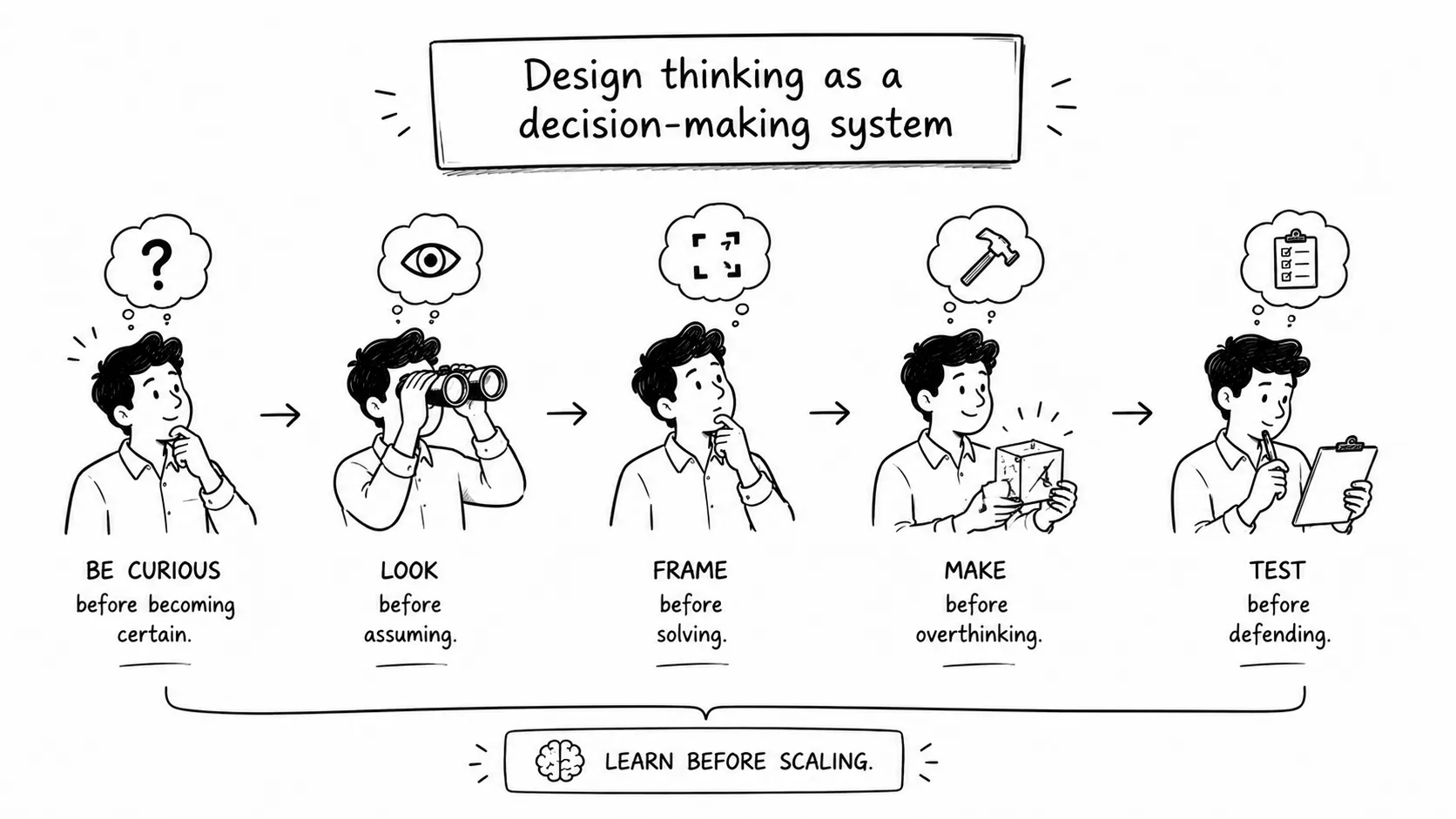
This is why I increasingly think of design thinking less as a process and more as a decision-making system. It creates habits around how we approach uncertainty.
- Be curious before becoming certain.
- Look before assuming.
- Frame before solving.
- Make before overthinking.
- Test before defending.
- Learn before scaling.
And perhaps most importantly:
Be willing to change your mind.
That is very different from following a prescribed sequence of activities. It also makes design thinking much more relevant beyond the design function.
- A product leader needs it.
- A founder needs it.
- An engineer solving an unfamiliar problem needs it.
- A business leader deciding where to invest needs it.
- An organization trying to understand how AI will change its business certainly needs it.
Because uncertainty doesn't belong to designers. It belongs to everyone making decisions about the future.
The danger of design thinking theatre
The biggest problem is not that organizations use frameworks. The problem is when the framework becomes theatre.
A workshop happens. People participate. The walls fill with sticky notes. Everyone feels energized. A report is produced. And then the organization returns to making decisions exactly as it did before.
The workshop didn't fail because the people weren't creative. It failed because the organization treated design thinking as an event rather than a capability.
- You cannot workshop your way into an innovative culture.
- You cannot certify your way into better judgment.
- You cannot outsource curiosity to a methodology.
The real question is whether the organization becomes better at seeing, questioning, learning and deciding. That takes practice. And it takes leadership.
What should we invest in?
This is becoming especially important as organizations decide how much to invest in AI. There is an obvious temptation to focus on tools.
- Which model?
- Which platform?
- Which agent?
- Which workflow?
- Which automation?
Those decisions matter. But there is another investment that is much easier to overlook:
How good are the people using these tools at thinking?
- Do they know how to frame a problem?
- Can they distinguish a symptom from a cause?
- Can they recognize when research contradicts their assumptions?
- Can they work with ambiguity?
- Can they identify what needs to be learned before something is built?
- Can they change direction without treating that change as failure?
Because the teams that benefit most from AI may not simply be the teams with the best tools. They may be the teams with the clearest thinking upstream of those tools.
Design thinking is a disposition
This is ultimately why I resist reducing design thinking to a process. A process tells you what to do. A disposition influences how you approach what you encounter.
It changes the questions you ask. It changes what you notice. It changes how comfortable you are with uncertainty. It changes how you respond when evidence contradicts your assumptions. And it changes your relationship with failure.
You stop seeing an unsuccessful prototype as wasted effort. You see it as information. You stop seeing a changed direction as indecision. You see it as learning. You stop seeing ambiguity as something to eliminate immediately. You see it as something to understand.
That is the capability worth building.
The real question for leaders
Design thinking does not need another framework. It needs to be understood for what it can actually offer.
- Not a five-step innovation recipe.
- Not a workshop format.
- Not a collection of activities.
A way of thinking when the answer is not obvious.
And perhaps that is why it matters more now than it did before. AI is making execution increasingly accessible. The ability to generate an answer is becoming cheaper. The ability to generate a good question remains valuable.
So when you think about your strategy for adopting AI, there is another question worth asking:
Are you investing only in the tools that accelerate execution, or also in the thinking that makes that execution worthwhile?
Because the teams that learn to combine both will have an advantage.
They won't just move faster. They'll have a better chance of moving in the right direction.