Finding Focus in a Fragmented Landscape
Turning behavioural research into strategic direction by uncovering opportunities that helped shape Microsoft's MSME growth strategy and market expansion across India.

“Turning behavioural research into strategic direction for Microsoft's MSME growth.”
- Client
- Microsoft India
- Industry
- Information Technology
- Year
- 2021–2022
- Role
- Research & GTM Strategy
Microsoft Teams had achieved significant global adoption, yet usage across India's MSMEs remained inconsistent. Many organizations continued relying on WhatsApp, phone calls and spreadsheets despite having access to Teams.
Microsoft wanted to understand where Teams could create meaningful business value, identify the right customer segments, and shape a go-to-market strategy grounded in how growing businesses actually worked.
Growing adoption within the Indian MSME ecosystem
Uneven usage despite platform availability
The research explored how MSMEs communicated, coordinated work and made decisions as they grew. The objective was to understand behaviours rather than evaluate product features.
Qualitative interviews and quantitative surveys revealed recurring patterns across businesses of different sizes and maturity levels. These insights became the foundation for segmentation and go-to-market strategy.
Cross-sector MSME research
Mixed-method approach
The research showed that collaboration challenges rarely stemmed from technology alone. Businesses adopted familiar tools because they aligned with existing workflows, decision-making habits and resource constraints.
Successful adoption depended less on introducing new features and more on fitting naturally into established ways of working. Understanding behaviour proved more valuable than understanding software preferences.
Collaboration centred around familiar communication channels.
Tool selection was driven by ease of adoption rather than functionality.
Business maturity influenced collaboration behaviour more than company size.
Existing workflows shaped technology decisions.
The research moved beyond isolated observations to identify recurring behavioural patterns shared across India's MSME ecosystem. These themes explained not only how businesses collaborated, but why existing behaviours persisted despite growing operational complexity.
Together, the themes became the strategic foundation for customer segmentation, value proposition design and go-to-market recommendations for Microsoft Teams.
Image 1 of 6
WhatsApp as the Business Backbone
MSMEs relied on WhatsApp as the operational backbone of their business. Rather than replacing it, future solutions needed to augment familiar workflows with lightweight structure and visibility.
Speed Over Structure
Owners consistently prioritised speed over formal processes. Successful products would need to embed structure without slowing everyday work.
Visibility Is the Real Problem
Most collaboration challenges originated from a lack of shared visibility rather than poor communication. Passive visibility emerged as a stronger value proposition than task management alone.
Tool Fatigue & Fragmentation
Businesses were overwhelmed by disconnected tools and sceptical of adding another platform. The opportunity lay in reducing fragmentation instead of introducing more complexity.
High Trust, Low Formality Culture
Relationship-driven businesses valued accountability but resisted systems that felt controlling. Any solution would need to reinforce trust while introducing greater operational clarity.
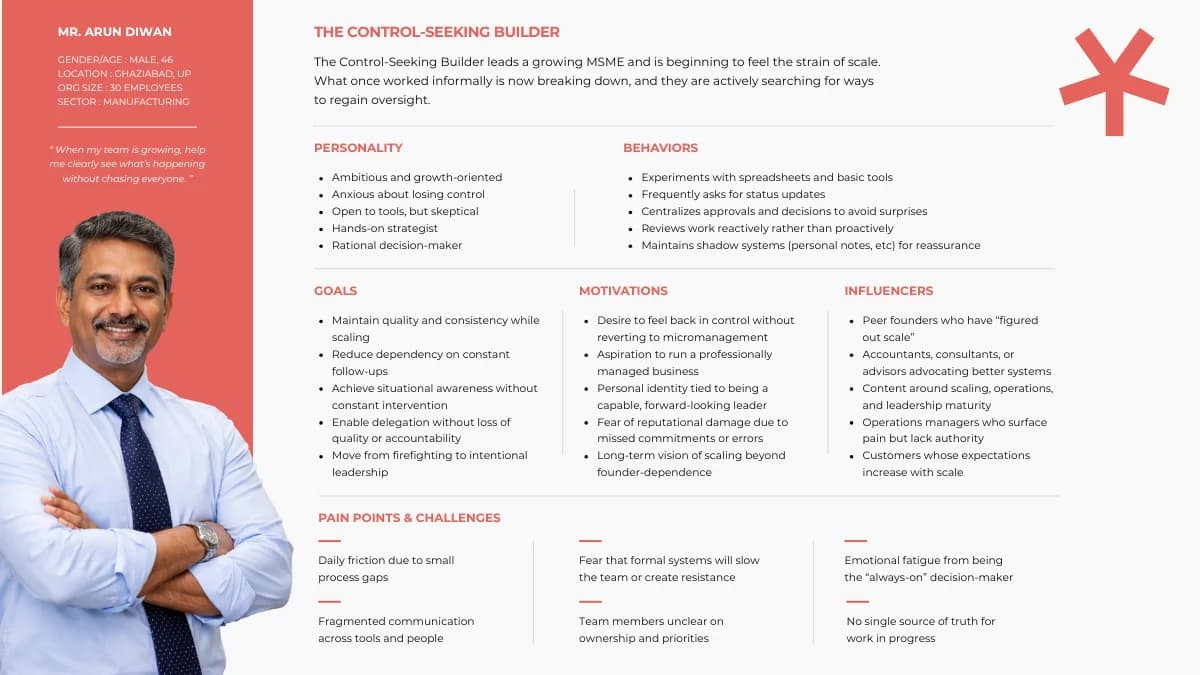
The research identified five behavioural personas representing different stages of MSME growth. Each reflected unique motivations, operational challenges and decision-making styles that influenced technology adoption.
These personas shifted the conversation from demographic segmentation to behaviour-led strategy, enabling Microsoft to tailor positioning, messaging and value propositions to real customer needs.
Image 1 of 6
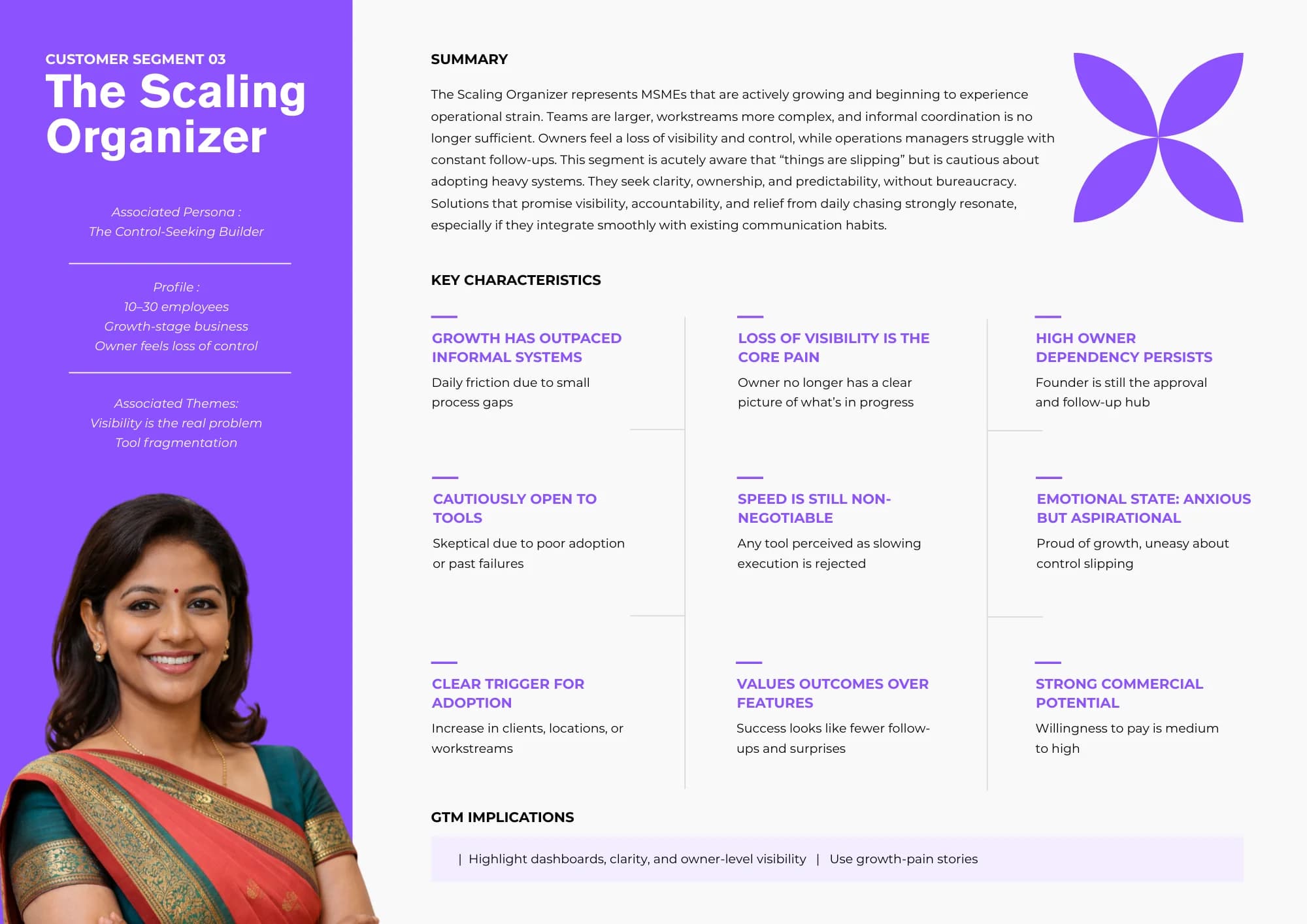
Behavioural themes and customer personas were synthesized into a go-to-market framework that aligned product positioning with the realities of India's MSME ecosystem.
Rather than promoting Microsoft Teams through features, the framework recommended contextual messaging, audience prioritization and adoption strategies that reflected how businesses naturally communicated, collaborated and grew.
Behavioural Foundation
Five behavioural themes explained collaboration patterns across MSMEs.
Customer Segmentation
Five personas translated behavioural patterns into addressable customer groups.
Value Proposition
Position Microsoft Teams around business outcomes instead of product capabilities.
Messaging Strategy
Tailor communication according to customer maturity, motivations and operational challenges.
Adoption Strategy
Reduce friction by aligning with existing workflows while gradually introducing greater structure and visibility.
Go-to-Market Recommendations
Audience-specific playbooks supporting product positioning, sales conversations and market activation.
The framework informed a series of audience-specific playbooks that connected behavioural insights with product positioning, messaging and adoption strategies. Each playbook addressed the unique motivations and challenges of a defined customer segment.
Rather than prescribing a single go-to-market approach, the recommendations enabled Microsoft to adapt conversations, value propositions and engagement strategies to different stages of MSME maturity.
Firefighter Founder
Position around speed and simplicity. Demonstrate immediate value with minimal disruption. Emphasize familiar workflows over new features.
Control-Seeking Builder
Position around visibility and operational clarity. Highlight task ownership, transparency and coordination. Focus on reducing management overhead.
Backbone Manager
Position around stress reduction and operational efficiency. Showcase centralized communication and task tracking. Simplify day-to-day coordination.
Trust-First Owner
Position around teamwork rather than monitoring. Reinforce accountability without compromising trust. Use human-centred language throughout the experience.
Modernizing Leader
Position around integration and scalable growth. Demonstrate ROI through consolidated workflows. Highlight long-term operational maturity.
The engagement transformed behavioural research into strategic direction, enabling Microsoft to better understand the communication and collaboration needs of India's MSME ecosystem. The findings provided a stronger foundation for market segmentation and customer engagement.
Rather than delivering a research report, the project produced practical frameworks, personas and go-to-market recommendations that supported product positioning, messaging and future market activation initiatives.
Behavioural Understanding
Identified five behavioural themes influencing collaboration across MSMEs.
Customer Segmentation
Defined five research-backed personas with distinct Jobs-to-be-Done and adoption motivations.
Go-to-Market Strategy
Developed a behavioural framework linking customer needs to positioning and messaging.
Sales Enablement
Created audience-specific playbooks to support product conversations and market activation.
Strategic Asset Library
Produced reusable research artefacts including themes, personas, frameworks and GTM recommendations that could inform future initiatives.
Strategy becomes actionable when research explains not only who customers are, but why they behave the way they do.