Establishing Design for Complexity
Transforming organizational complexity into coordinated action by aligning people, processes and technology across one of India's largest digital transformation initiatives.

“Outcomes are more resilient when design becomes a part of how you think.”
- Client
- Government of Rajasthan
- Industry
- Public Sector
- Year
- 2022–2024
- Role
- Engagement Lead
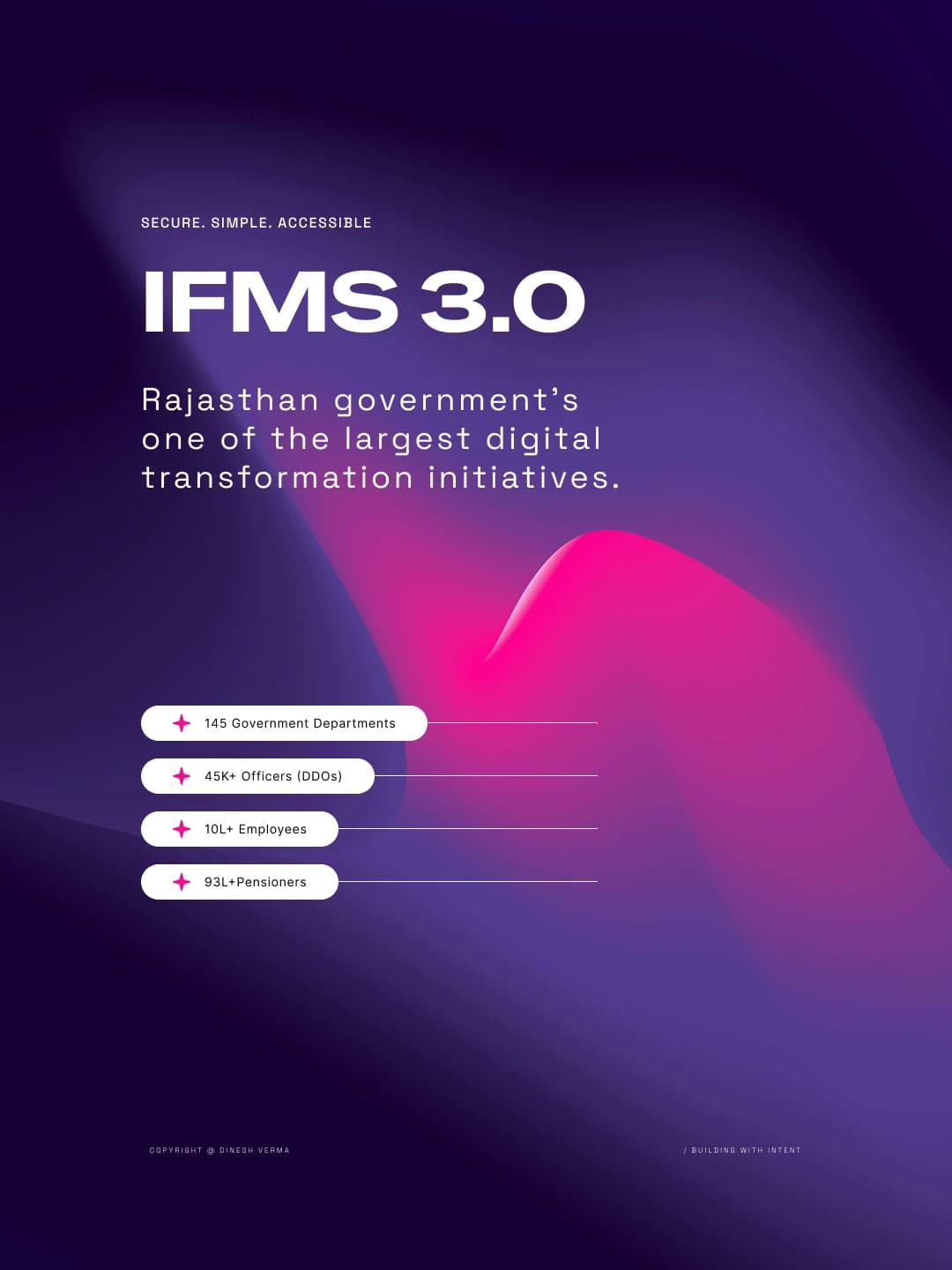
The programme presented an opportunity to rethink how a large and interconnected public financial system could deliver consistent, efficient and user-centred experiences across diverse stakeholders.
The challenge extended beyond interface design. It involved aligning multiple departments, introducing design into an established delivery ecosystem and creating a shared approach that could scale.
IFMS 3.0 was a flagship digital transformation initiative for the Government of Rajasthan. Its success depended on enabling thousands of users across government departments to adopt new ways of working with confidence.
Working at this scale required balancing policy, governance, operational realities and user expectations while ensuring that design remained connected to both business objectives and implementation constraints.
The programme operated across one of the largest public sector financial ecosystems in India.
Parallel Rollouts
Parallel product and service rollouts
Shared Governance
Cross-functional programme governance
Design Capability
Design capability established within delivery teams
Operating Model
Shared operating model supporting scalability
As Engagement Lead, I was responsible for establishing the design practice within the programme and positioning design as a strategic capability rather than a downstream function.
I worked across business, technology and delivery teams to align stakeholders, shape direction and enable design to contribute meaningfully throughout the transformation lifecycle.
Rather than treating design as a phase within delivery, I focused on embedding it into the programme's operating model. This meant establishing clear ways of working and evidence-based decision making.
The approach balanced user needs, business priorities and implementation realities, ensuring that design became an integral part of how complex problems were understood and delivered.
Established the design practice for the IFMS 3.0 programme while building and mentoring a multidisciplinary design team.
Embedded user-centred design and research into programme delivery to inform decisions with evidence rather than assumptions.
Worked closely with business, technology and delivery teams to align priorities, strengthen collaboration and support better decision making.
Supported multiple parallel workstreams while maintaining consistency across experiences through shared design principles and ways of working.
The programme established design as a strategic capability within one of India's largest public sector digital transformation initiatives. It created a stronger foundation for collaboration and decision making across multiple workstreams.
Established a dedicated design practice within the programme.
Embedded user-centred design into delivery and governance.
Improved alignment across business, technology and delivery teams.
Created reusable design foundations to support future programme evolution.
Complex engagements often struggle with fragmented decision making and the absence of shared intent.